Every Ghost Story Is a Love Story: What The Haunting of Hill House Taught Me About Blooming Again
I watched "The Haunting of Hill House" with my family, curled into a sofa with all the lights switched off, purely for the pleasure of being frightened together. That was the entire plan. And then, somewhere around the third episode, the plan quietly dissolved, and I found myself doing the thing I suspect happens to more of us than we admit: watching a piece of entertainment through the lens of one's own profession, unable to switch it off, turning a ghost story into a case study without ever meaning to.
(A quick note before we begin: I've kept this deliberately spoiler-light, so if you haven't watched it yet, you're safe to keep reading.)
I don't know if this is a universal affliction or simply an occupational one — years spent in psychology, in sociology, in classrooms, watching how people construct and defend and eventually dismantle the stories they tell about themselves. But somewhere along the way, I stopped watching a horror series and started watching an extraordinarily precise portrait of midlife, grief, and the particular architecture of the self — which is to say, I was watching 'my work'.
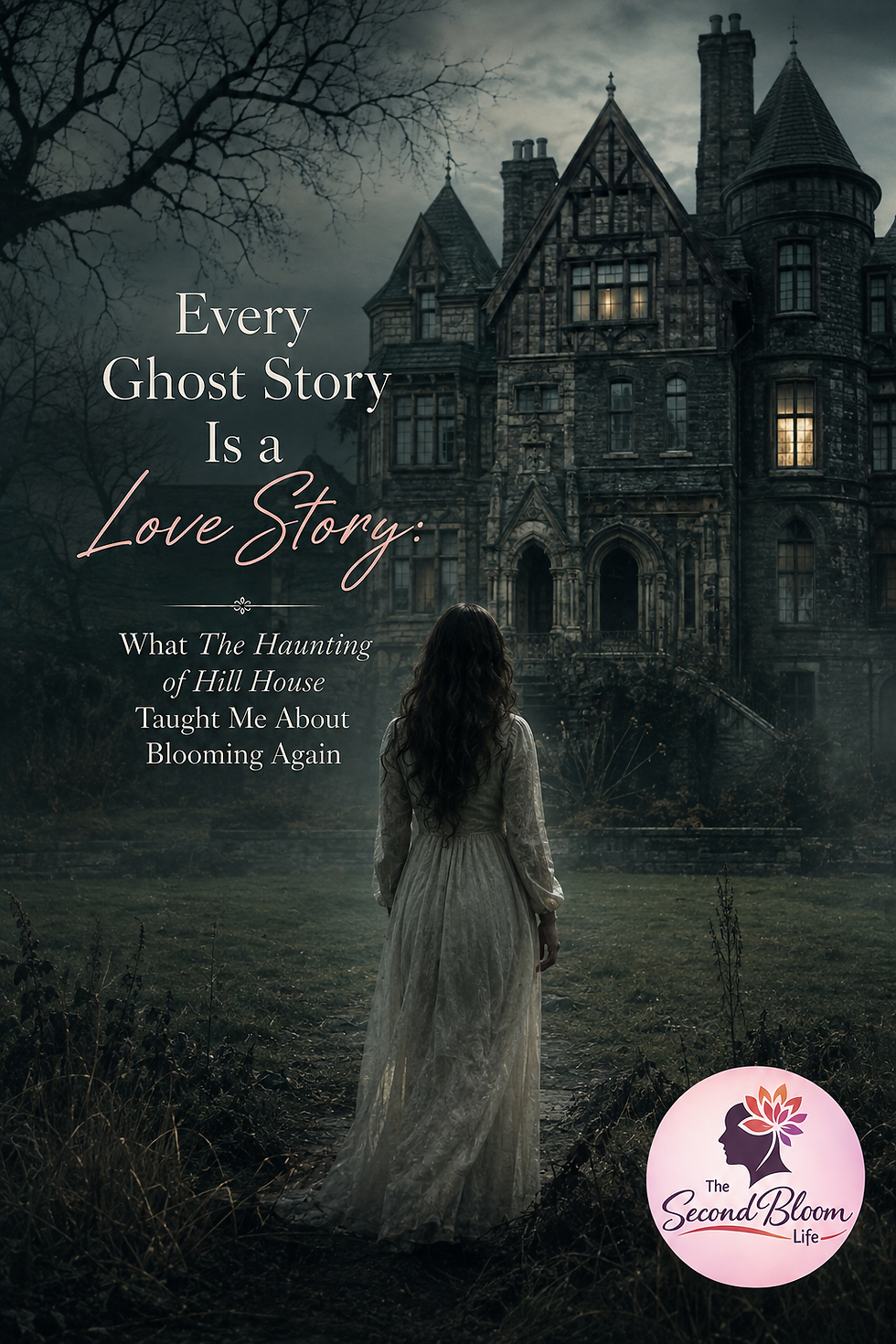
If you haven't seen it, the premise is deceptively simple: a family lives, for one summer, in a vast and unsettling house. Something happens there. They leave. Decades later, each of the grown children is still, in their own way, living inside that house — in their marriages, their habits, their careers, their carefully controlled lives — even though none of them have set foot in it for years. The house was never really the setting. The house was the metaphor, walking around fully dressed as a horror story, hoping nobody would notice.
What stayed with me wasn't the jump scares, satisfying as they were. It was the quieter idea underneath them: that this house seems to offer each person exactly what they're missing, exactly what feels safest, so gently that they mistake it for comfort rather than for what it eventually reveals itself to be. I won't say more than that — how each of them discovers what it actually costs them is one of the most devastating parts of watching it unfold, and I wouldn't dream of taking that from you. But I recognised the shape of it instantly. I have sat with enough women navigating their own midlife reinvention to know that we all have a room like that somewhere. It rarely looks like danger. It looks like the identity we built to survive something, dressed up as comfort, furnished so beautifully that we forget who is really being kept there.
There's also a fear that follows one of the sisters for the whole of her life — an apparition she never stops running from, no matter how far or how carefully she tries to outpace it. Without giving away what it turns out to be, I'll say only that it undid me completely, and that I think of how often we do something similar in our own lives — treat our fear as something chasing us from behind, when really it's a version of ourselves we haven't yet made peace with, standing further up the corridor, patient, unavoidable. So much of what I call decluttering in this work is exactly that: turning around. Looking properly, for the first time, at the thing we've spent years politely refusing to see.
There's a single line, spoken quietly near the end, that I've turned over for days since: *every ghost story is a love story.* It reframes everything that came before it — the hauntings aren't punishments, they're what's left of love that had nowhere else to go: grief that never got spoken aloud, fear for the people we love curdled into something monstrous by silence, a family so afraid of losing each other that they nearly lost each other trying to hold on. It is, I think, the truest thing I've encountered this year about why we struggle to let go of who we used to be. We don't cling to our old rooms, our old identities, our old griefs, because we're weak. We cling to them because, once, they were how we loved and were loved. Leaving them doesn't mean the love wasn't real. It means we're finally ready to carry it differently.
That, to me, is the whole of the Second Bloom in a single image: not a woman running from a haunted house, but a woman finally walking back into it, room by room, with the lights on this time, deciding consciously what she keeps and what she finally, tenderly, lets go. Not because the past was worthless. Because she has done her grieving properly, and she no longer needs the house to hold it for her.
I watched this with my husband and 3 sons, three grown men who have their own hauntings forming already, their own rooms they'll furnish and outgrow and one day have to walk back into. There was something quietly moving about being frightened alongside them, all of us on the same sofa, none of us saying anything about what we actually saw in it. Perhaps that's its own small love story too.
So yes — I went looking for scares, and I found, instead, an unexpectedly precise vocabulary for the work I do and the life I'm living. Professional deformation, if that's what this is, turns out to be rather a gift. It means even a ghost story can hand you back your own reflection, and if you're paying attention, that reflection has something worth listening to.
If you've seen it, I'd love to know which room was yours.


Comments