Redirection, Not Rejection: A Midlife Mindset Shift That Changes Everything
- thesecondbloomlife
- Apr 23
- 3 min read
Midlife has a way of disrupting even the most carefully laid plans—and when it does, it can feel deeply personal. A role you expected to grow into disappears. A relationship changes or ends. Opportunities you felt certain about simply don’t land. It’s easy to see these moments as rejection, as if something about you wasn’t enough.
But what if that isn’t the full story? What if what feels like rejection is actually redirection—quietly guiding you towards a life that fits who you are now, not who you were expected to be years ago?
By midlife, most people have spent decades building identities. You may have been the dependable one, the achiever, the caregiver, the person who held everything together. So when something doesn’t work out, it can feel like a direct challenge to your value.
In reality, many of these moments have far less to do with your worth and far more to do with alignment. Timing changes. Priorities evolve. And often, what once suited you no longer does.
Consider this: A woman in her early fifties was passed over for a promotion she had worked towards for years. Initially, she experienced it as a setback and questioned her capabilities. But when she stepped back and looked at her life honestly, she realised she no longer wanted the demands that role would bring. Within a year, she transitioned into consultancy—earning more, working on her own terms, and feeling a renewed sense of control. What looked like rejection turned out to be a release.
Or take the example of a man navigating a late-life divorce. At first, he saw it as failure. Over time, he began to recognise how much of himself he had set aside to maintain the relationship. That ending created space for stronger boundaries, deeper self-respect, and eventually a healthier partnership. What felt like loss became a return to himself.
Even in career shifts, this pattern holds. Being told “no” can feel definitive, but it often carries information.
One client applied for a senior role and didn’t get it. Instead of internalising it, she sought feedback. It became clear her strengths were better suited to strategic leadership than operational management. She retrained, repositioned herself, and stepped into a role that was not only more aligned but more rewarding. The outcome changed because her direction did.
This is the shift that defines a powerful midlife mindset. It’s not about avoiding disappointment. It’s about learning how to interpret it differently. The moment you stop taking everything personally, you begin to see more clearly. You ask better questions. You make more intentional decisions. You stop forcing paths that no longer fit and start choosing ones that do.
Practically, this means pausing before you personalise an outcome. Instead of assuming something didn’t work because you weren’t enough, consider whether it was about timing, fit, or direction.
It means extracting useful insight from the experience rather than getting stuck in the emotion of it. Every situation offers feedback if you’re willing to look for it. It also means redirecting your energy. Adjust your goals, explore new options, and be open to paths you may not have considered before. And perhaps most importantly, it means strengthening your emotional boundaries. Not every outcome deserves to define how you see yourself. There is a quiet advantage to this stage of life that often goes unrecognised. By midlife, you have perspective. You understand yourself more deeply. You are less willing to tolerate what doesn’t feel right.
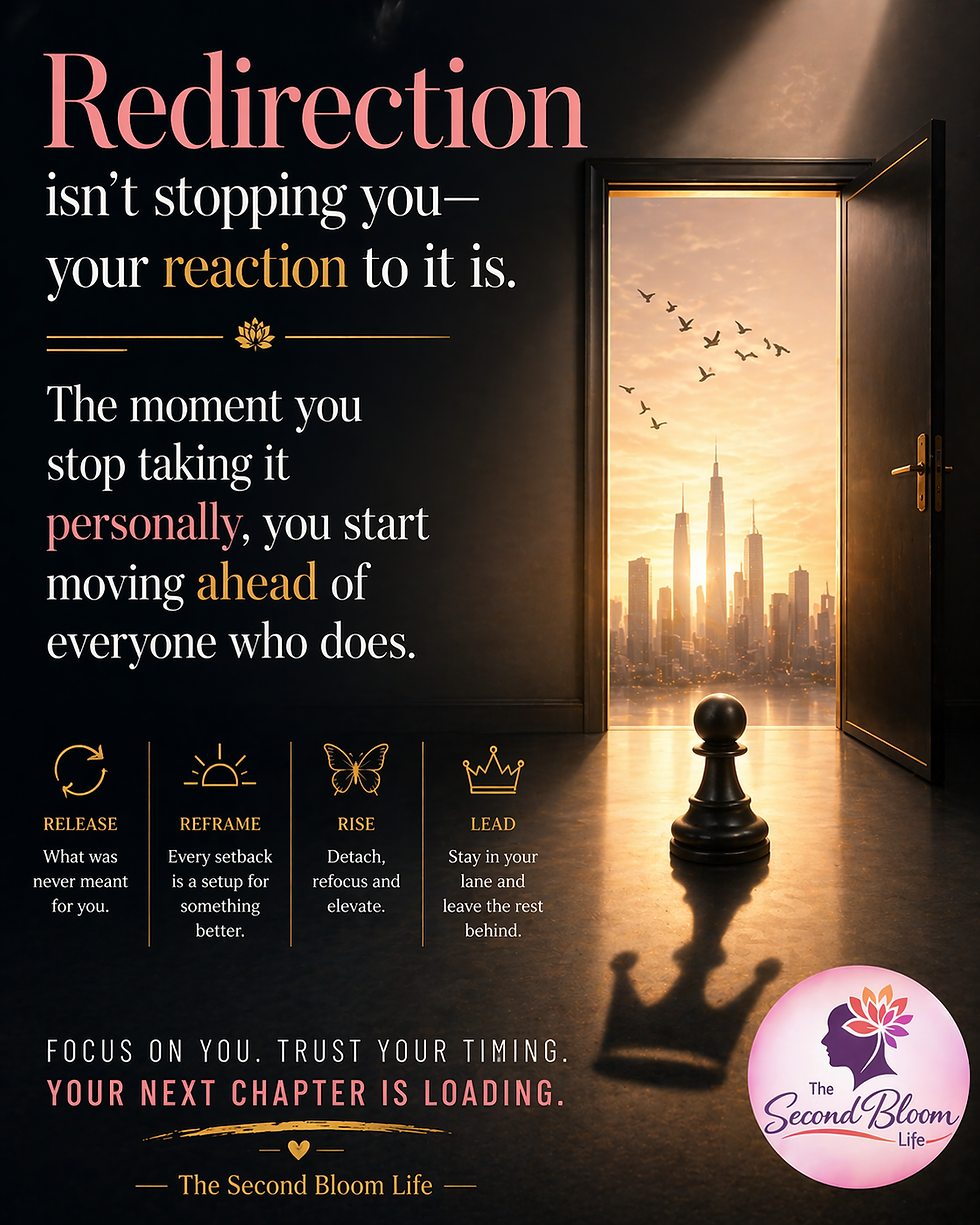
That combination—self-awareness, experience, and clarity—creates the conditions for meaningful change. Redirection rarely feels comfortable in the moment. It can look like uncertainty, delay, or even loss. But very often, it is the beginning of something more aligned, more intentional, and ultimately more fulfilling. The moment you stop taking everything personally, you create space for something far more powerful than validation—you create space for alignment. And from there, everything starts to shift.
Your bloom. Your rules. Your life.
— The Second Bloom Life


Comments