The Memory Trap: When Sentimental Clutter Keeps You Living in the Past
- thesecondbloomlife
- Jun 25
- 8 min read
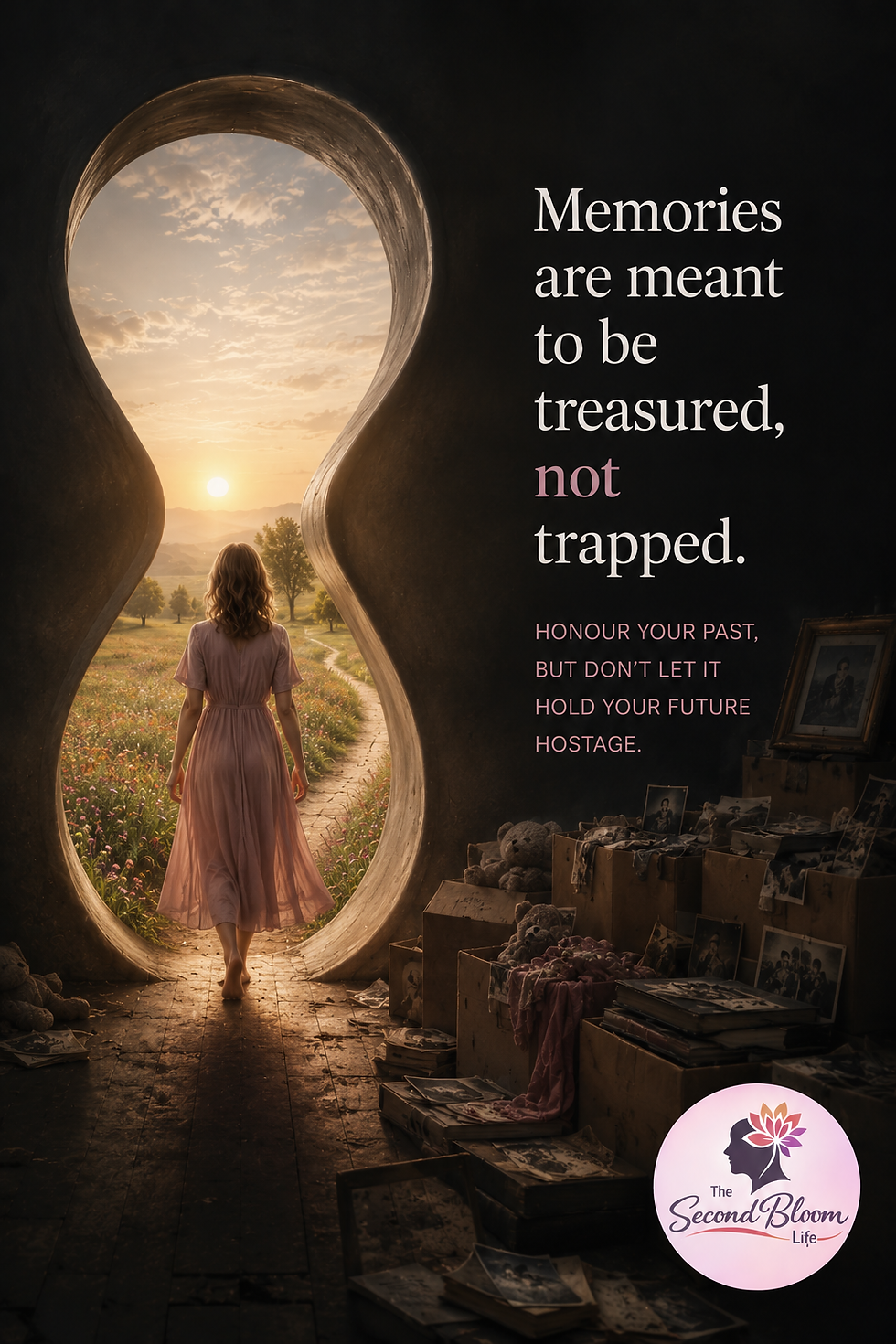
Most decluttering advice is fundamentally about objects.
Sort them. Organise them. Donate them. Release them. Move on.
And for a great deal of what fills our cupboards and clutters our shelves, that approach works perfectly well. But sentimental clutter is an entirely different matter — because sentimental clutter is almost never really about the object itself. It is about the memory woven into it. The moment it carries. The person it conjures. And memories, as any of us who have tried to "just let go" of something precious already know, are far harder to place in a donation bag than a winter coat that no longer fits.
This is perhaps the most tender territory we will explore in this series. I ask you to approach it gently — with yourself, and with whatever surfaces as you read.
The Box in the Cupboard
Most of us have one. Tucked at the back of a wardrobe, wedged onto a high shelf, living in the dark of a spare room cupboard. Inside: a layered archaeology of a life. Photographs of people who no longer look the way you remember them. Letters written by hand in ink that has faded. Birthday cards saved from children who are now adults. Theatre programmes. Concert tickets. A child's first drawing, rendered in uncertain crayon. A souvenir from a holiday that felt, at the time, like the beginning of something.
These are the objects of a life fully lived, and there is nothing wrong — nothing at all — with keeping the ones that genuinely matter.
Memory is not mere nostalgia. Psychologists who study the role of autobiographical memory in wellbeing consistently find that our capacity to access a coherent personal narrative — to know where we came from, what we have survived, who we have loved — is deeply connected to our sense of identity, meaning, and resilience. We are, in a very real sense, the stories we remember. Keeping meaningful objects that anchor those stories is not clutter. It is self-knowledge.
The problem begins not with keeping, but with the particular quality of the keeping. There is a point at which we stop visiting our memories and start living inside them — and that is where the trouble, quiet and slow-moving as it is, begins.
The Difference Between Honouring and Clinging
There is a distinction I return to often in my work with clients, and it is worth naming clearly: the difference between honouring the past and clinging to it.
Honouring allows the memory to enrich the present. It visits the past with gratitude, draws something nourishing from it, and returns. Clinging, by contrast, asks the present to compete with the past — and the present almost always loses, because memory has a particular advantage over lived experience: it has already been edited.
I worked with a client — a warm, thoughtful woman in her early fifties — who described spending the years after her youngest child left home in a state she could only call "stuck." She had not moved anything in her son's bedroom. His posters remained on the wall. His trophies sat exactly where he had left them. She would sit in there occasionally, not quite sad, not quite content, suspended somewhere between the life she had loved and the life she did not yet know how to begin.
She was not grieving, precisely. She was hovering. The room had become less a memorial and more a holding pattern — a way of not yet having to answer the question of what came next.
One creates gratitude. The other creates longing. And longing, sustained over years, becomes a quiet kind of paralysis.
Memory Is Not a Photograph
One of the most humbling and liberating discoveries in the psychology of memory is this: memory is not a recording. It is a reconstruction.
Every time we revisit a memory, we do not simply press play on a stored file. We actively rebuild it, and in the rebuilding, we make choices — conscious and unconscious — about what to emphasise and what to allow to fade. Over time, this process produces what researchers call the rosy retrospection effect: the difficult, ordinary, and frustrating elements of a past experience gradually soften, while the warmth and brightness intensify.
This is why the summers of our childhood seem impossibly golden in retrospect. Why a marriage we know was complicated can feel, in memory, simply tender. Why the years when our children were small — exhausting, relentless, uncertain years — can seem in hindsight like the most luminous period of our lives.
We are not misremembering dishonestly. We are simply doing what human memory does: editing for emotional significance.
But this also means that when we compare today's life against yesterday's memories, we are never making a fair comparison. We are measuring the unedited present against the highlight reel of the past. No wonder the past can seem so appealing. No wonder today can feel, despite everything, slightly insufficient.
Understanding this does not diminish the beauty of what we remember. But it does offer us a little gentle permission to be present to where we actually are.
Why Midlife Makes Us Especially Vulnerable
Midlife is, almost by definition, a season of transition — and transition, however welcome, is inherently destabilising. Children leave home. Careers evolve or end. Relationships shift in ways we did not anticipate. Parents age, or are no longer here. Our own reflection begins to change in ways we cannot fully control. The landscape of our daily life can look, in a relatively short space of time, almost unrecognisable.
Whenever the present feels uncertain or unfamiliar, the past exerts a stronger pull. This is entirely human — the brain, under conditions of stress or ambiguity, instinctively seeks the known. And so we hold on. To objects. To photographs. To the roles we used to inhabit so naturally. To an earlier version of ourselves that felt more fixed, more certain, more legible.
Sometimes the holding on serves us. It steadies us through a difficult crossing. But when it continues past the point of comfort and into something more habitual — when the past becomes not a resource but a residence — it quietly prevents us from arriving at what is next.
The T-Shirt Realisation
I want to share something personal here, because I think it illustrates the shift in thinking that makes all of this possible.
Some years ago, I came across an old T-shirt at the back of a drawer — soft with age, faded, belonging to a particular season of my life that had been genuinely happy. A simpler time. A lighter time. For a moment, I considered keeping it. Not because I would ever wear it again, and not because it had any objective value, but because the memories attached to it felt precious and I was not sure I trusted myself to keep them without the object as an anchor.
And then something shifted.
I realised, sitting there holding this worn-out piece of fabric, that the memories did not live in the cotton. They lived in me. The T-shirt was never the memory itself — it was simply the trigger for it. A key, not the room it unlocked.
And once I understood that, the releasing became something entirely different. Not a loss. A transfer. I was not discarding the memory. I was simply recognising that I no longer needed an external prompt to access it.
The memory stayed. The clutter did not.
The Stories That Keep Us Stuck
Much of sentimental clutter survives not because we have thought carefully about it, but because of the stories we tell ourselves when we contemplate letting it go.
If I throw this away, I am forgetting. If I let this go, it means it did not matter. If I release this, I am somehow betraying the person, or the time, or myself.
These stories feel true in the moment. They are not.
You do not honour a loved one by keeping every object associated with them. You honour them by carrying what they meant to you — the values, the warmth, the particular quality of the love — into the life you are still living. That is far more meaningful, and takes up considerably less cupboard space.
You do not preserve a memory by surrounding yourself with physical evidence of it. You preserve it by allowing it to live where memories actually live: within you.
And you do not keep your past alive by refusing to make room for your future. You keep it alive by allowing it to have shaped the person who walks forward.
Practical Ways to Work Through Sentimental Clutter
This is territory that deserves patience, so please approach it slowly. Here are some approaches that work well.
The curation method. Rather than attempting to release everything at once, choose to curate. Ask yourself: if I could keep only ten items from this box, which ten would they be? This shifts the question from "what should I get rid of?" — which feels like loss — to "what do I most want to keep?" — which feels like choice. The items you do not choose often become far easier to release once you have consciously selected what matters most.
The memory book. For cards, letters, photographs, and children's drawings that carry real significance but have outgrown their usefulness as physical objects, consider creating a memory book or a digital archive. Scan or photograph the items, compile them into a printed album or a simple folder, and release the originals with genuine care. The memory is preserved. The stack of ageing paper is not.
The one representative rule. We sometimes keep fifty objects connected to a single person, season, or experience, when in truth one or two would carry the same emotional weight. If your box contains thirty cards from a particular relationship, choose the two or three that say what you most need to remember, and release the rest. Abundance of objects does not equal abundance of memory.
The "does this serve the living?" question. A particularly powerful question when working with objects connected to those who have died: would this person want me to carry this, or to be freed by letting it go? Most of us, if we are honest, can hear the answer clearly.
The transitional ritual. For items that feel genuinely difficult to release, try creating a small, deliberate ceremony around the letting go. Write a few words about what the object represented. Read them aloud if that feels right. Thank the object for what it carried. Then release it — to a charity, to a person who might use it, or, where appropriate, to the earth or the sea. Rituals of release are not dramatic or indulgent. They are simply the way we acknowledge that something mattered, and then make a conscious choice to move.
The Courage to Keep Moving Forward
One of the greatest and most underrated challenges of midlife is learning to carry our memories without allowing them to carry us.
The goal is not to forget. The goal is not to become detached or insensible to what has been. The goal is to appreciate what was — fully, gratefully, without apology — while remaining genuinely present to what is.
To allow the past to have a honoured place in our story, whilst refusing to give it the final word.
To hold the beautiful chapters with tenderness, and then turn the page.
A Reflection Before the Next Article
Before you read on in this series, I invite you to spend a little time with your box — wherever it lives in your home.
Do not attempt to clear it. Simply open it, and as you look through what is there, ask yourself honestly:
Am I visiting these memories, or am I living in them?
Which of these items am I keeping out of love, and which out of guilt or fear?
What would it mean — not materially, but emotionally — to let just one thing go?
Notice what comes up. Sit with it without rushing toward an answer.
The past you have lived is a remarkable thing. It deserves to be honoured, carried with you, and allowed to enrich the life still ahead of you.
It does not deserve to be the ceiling that stops you from rising.
Next in the series: Decluttering Your Calendar — why being perpetually busy is not the same as being fully alive, and how to reclaim your time for the things that actually matter.


Comments