The Strange Comfort of Supermarkets
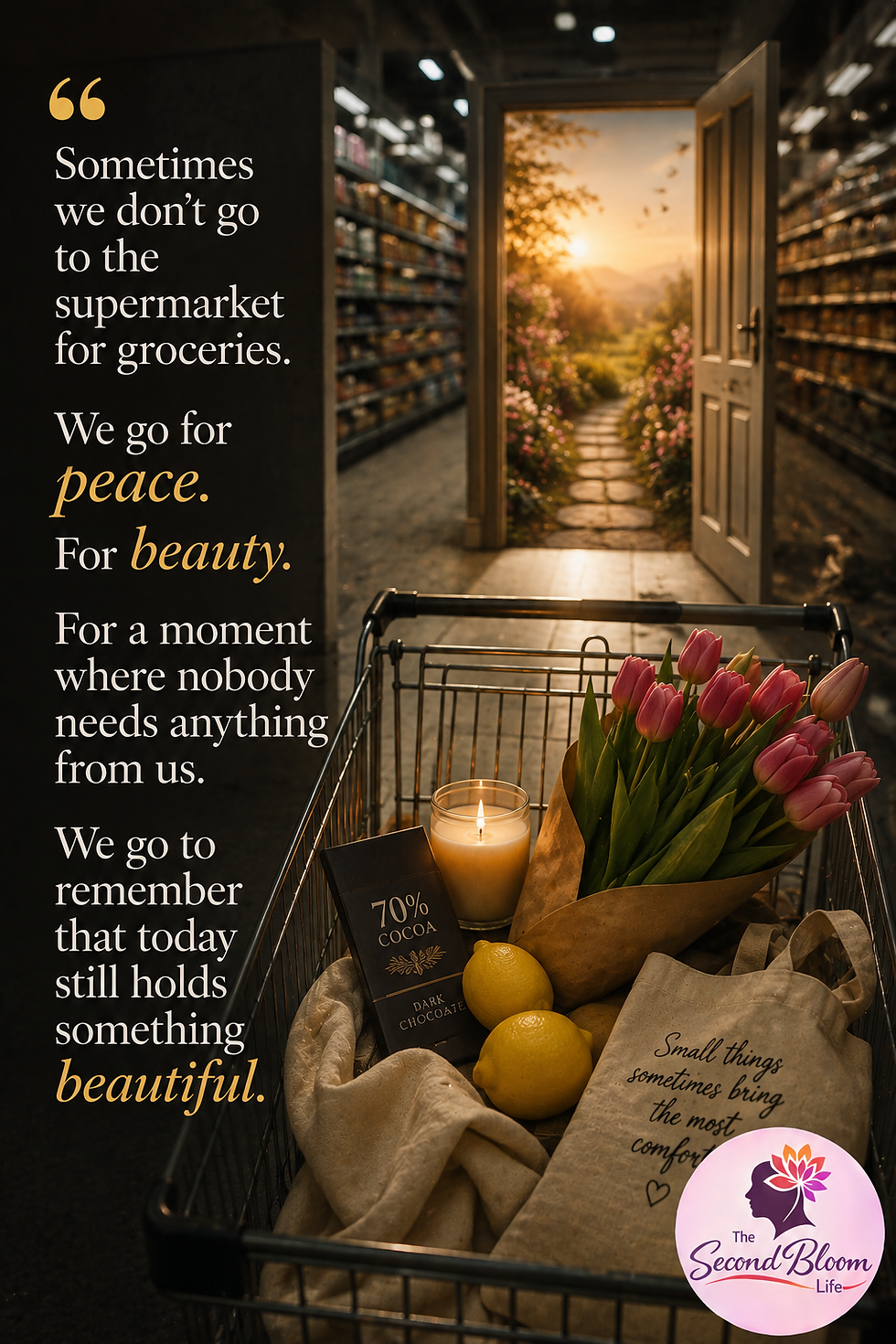
Why do we wander supermarket aisles when we don't actually need anything?
A few weeks ago I'd had one of those days. Nothing dramatic, nothing you could point to and name. Just the quietly draining kind, where every ordinary conversation costs slightly more energy than you seem to have on hand. The fridge was already full. The week's shopping was done. And yet, without deciding to, I found myself pushing a trolley through the supermarket anyway — no list, no urgency, no real reason to be there at all.
I drifted through the fruit and veg. Stopped at the flower buckets for longer than flowers usually warrant. Read the back of a packet of biscuits I had zero intention of buying, purely to see what it said. Walked every single aisle, including the ones I never normally visit. By the time I reached the till, my basket held three lemons, a scented candle, a bar of dark chocolate and a small bunch of tulips — not one item on it strictly necessary. And yet I left feeling noticeably lighter than when I'd arrived.
I used to think this was just a personal quirk. Turns out it isn't.
What was actually in the basket
Here's roughly what came home with me that evening, and, once I looked closely, what each thing was quietly doing there.
Three lemons — nothing to cook, just the smell of them on my hands. A candle — not for anyone's benefit but my own, lit for no occasion at all. Dark chocolate — small, deliberate, entirely for pleasure. Tulips — proof, cheaply bought, that the day still contained something beautiful.
None of it solved anything. All of it helped anyway.
Why the aisles themselves are doing something to us
Supermarkets are almost aggressively predictable. Milk here, bread there, coffee two aisles along, exactly as it was last week and the week before that. Move one section around and people get oddly, disproportionately irritated — which tells you something. That predictability is doing real work. Your brain already knows how to move through the space without effort, and when the rest of life feels unmoored, that kind of low-grade certainty is more soothing than it has any right to be.
There's a second layer sitting underneath it. Psychologists have long noted that overwhelmed minds calm down, oddly, by being handed very small decisions to make. Green apples or red. Basil or parsley. This tea or that one. None of these choices cost anything emotionally, yet each one quietly tells the brain I can still choose things — and after a day spent feeling like very little was within your control, that message lands harder than it sounds.
It isn't really shopping
One client told me, laughing at herself slightly, that whenever work tips into overwhelming she somehow ends up wandering Marks & Spencer with no plan at all. Another gravitates to garden centres. Someone else to bookshops. A fourth to homeware stores, running her hand along cushions she has no intention of buying. These places have almost nothing in common on paper — except that each one is calm, unhurried, visually pleasant, and asks absolutely nothing of the person walking through it. Perhaps that's the actual product being bought in all these cases: not the object, but a few minutes of permission to just be somewhere gentle.
It isn't an accident, either, that supermarkets now greet you with fresh flowers at the door, soft lighting over the bread, fruit arranged like a still life. Retail psychologists understand something specific: beauty slows people down, and slowing down changes how they feel. Buying flowers on an ordinary Tuesday isn't always about the vase they'll end up in. Sometimes it's a small, physical reminder that today still has something worth noticing in it.
A shift I've noticed in myself
Shopping used to mean excitement when I was younger — fashion, the latest thing, whatever everyone was talking about. These days I find myself drawn to good olive oil, decent coffee, a fresh loaf, a soft blanket, a candle that smells like somewhere I'd like to be. I'm no longer shopping for status. I'm shopping for atmosphere, and I think that's one of the more understated gifts midlife hands us. Sociologists have long argued that what we buy tells the story of who we are; I suspect that in midlife, it starts telling the story of who we're quietly becoming instead — not louder, but softer; not busier, but calmer; not impressive, just meaningful. That might be exactly why a good loaf of sourdough can feel more satisfying now than another handbag once did. Not because our standards dropped. Because they finally rose to something that actually holds up.
A different question to carry down the next aisle
Next time you find yourself wandering a supermarket with no real list, try swapping the usual question. Instead of "what do I need," ask "what feeling am I hoping to bring home with me." You may discover you were never really after groceries. You might have been after peace, or beauty, or simply somewhere quiet enough to hear your own thoughts again for five minutes.
You could even go looking for it on purpose this week. Walk your favourite shop slowly, without a list, and notice what genuinely catches your eye rather than what you technically need. Then pick one small thing that would make an ordinary evening feel a touch more beautiful — flowers, warm bread, a new tea, a candle, whatever fruit looked best today — and take it home on purpose. Not because you've earned it. Because you're here, and that's reason enough.
I've become fairly convinced, after years of this work, that we spend too much energy hunting for happiness in extraordinary experiences, when so much genuine contentment turns up disguised as ordinary ritual: flowers on a Tuesday, the good coffee instead of the usual jar, a slow walk down a familiar aisle, soup on the stove with music playing, a candle lit before dinner for no one but yourself. None of it fixes anything. All of it reminds you that beauty is still available, even in the uncertain seasons — sometimes sitting quite literally between the apples and the bread, waiting to be noticed.
So the next time everything feels like too much, try resisting the urge to rush past it all, and ask instead what small act of beauty might help you feel a little more at home in your own life today. Healing rarely arrives as a single dramatic breakthrough. More often, it comes home in a shopping bag, looking like almost nothing at all.
Coming next in The Unexpected Psychology of Midlife — Why We Read the Same Book Again. You already know the ending. So why does your hand keep reaching for the same story? Perhaps we don't reread books because they've changed. Perhaps we reread them because we have.


Comments