When Connection Stops Being Automatic: Respect in Midlife (Part 1)
- thesecondbloomlife
- May 7
- 4 min read
If trust becomes quieter and more internal in midlife, then respect becomes more visible — not necessarily in what is said, but in what is consistently done. And this is where many relationships begin to shift in ways that are not always immediately recognised. Respect at this stage is rarely about obvious disregard or overt behaviour. It is more subtle than that. It shows up in tone, in attention, in whether someone feels taken seriously — or gradually overlooked. Earlier in life, respect is often built into roles. You respect the structure of the relationship, the responsibilities each person holds, the effort being made. There is a shared understanding of how things work. But as midlife unfolds, those roles evolve, expectations adjust, and with that, respect needs to be re-established rather than assumed.
This is often where tension begins quietly. You may notice it in small, almost unremarkable ways: being interrupted more often, feeling your opinion is acknowledged but not really considered, or sensing that conversations have become more functional than mutual. Equally, you may notice changes in yourself — less patience, more directness, less willingness to soften your tone. Respect rarely disappears in any obvious way; it tends to thin out gradually. A client once put it quite precisely: “We’re not disrespectful… but we’re not careful anymore either.” That distinction is important, because respect is not static. It is not something that, once established, simply remains. It needs to be maintained through behaviour, not history. What worked ten or fifteen years ago may no longer feel appropriate now. The way you speak, listen, respond, and acknowledge each other needs to evolve alongside the relationship itself. Humour that once felt easy may now feel dismissive. Silence that once felt comfortable may now feel like disengagement. Not because either person is wrong, but because the context has changed.
At the same time, midlife often brings a shift towards greater honesty. Many people become less inclined to filter what they think or accommodate unnecessarily. This can be refreshing, but without awareness it can also become sharp. There is a difference between being clear and being dismissive. Saying, “That doesn’t make sense,” may feel efficient, but saying, “I’m not sure I understand your thinking — can you explain it?” maintains both clarity and respect. The adjustment here is not to become less honest, but to become more intentional with how that honesty is delivered. Respect is not lost through disagreement; it is often reduced through tone.
It is also worth paying attention to the everyday signals. Respect is rarely demonstrated in large gestures. It is built — or diminished — through repeated, ordinary interactions. Whether you look up when the other person is speaking, whether you respond thoughtfully rather than quickly, whether you acknowledge their point even when you disagree — these small moments shape how the relationship feels over time. One of the simplest but most effective shifts is to slow your responses slightly, not to overanalyse, but to allow your reply to reflect what has actually been said rather than what you assumed was being said.
There is, however, a particular risk in long-term relationships where familiarity begins to replace attentiveness. You know each other well, you anticipate responses, you shorten conversations. And without intending to, you stop being as careful. You may speak more abruptly, listen less fully, or assume rather than ask. A slightly familiar — and often quietly amusing — moment might be this: one person is halfway through explaining something that matters to them, and the other interrupts with, “Yes, yes, I know what you’re going to say.” And perhaps they do. But that is not the point. The point is being heard. Familiarity can create efficiency, but it can also reduce presence.
Practically, restoring or maintaining respect does not require large changes. It requires consistent awareness. Letting the other person finish fully before responding. Acknowledging their point, even if you see it differently. Asking one clarifying question rather than assuming. Adjusting tone, not just content. Noticing when impatience begins to surface, and pausing there. These are small adjustments, but they accumulate and shift the overall dynamic of the relationship.
There is also an internal aspect that should not be overlooked. Respect is not only how you treat others, but how you allow yourself to be treated. Midlife often brings a reduced tolerance for what feels dismissive, unbalanced, or quietly undermining. You may find yourself less willing to accept dynamics that you previously overlooked. This is not becoming difficult; it is becoming clearer. Saying, “That doesn’t feel right to me,” or “I’d like us to approach this differently,” is not unnecessary confrontation. It is a way of maintaining the standard of the relationship.
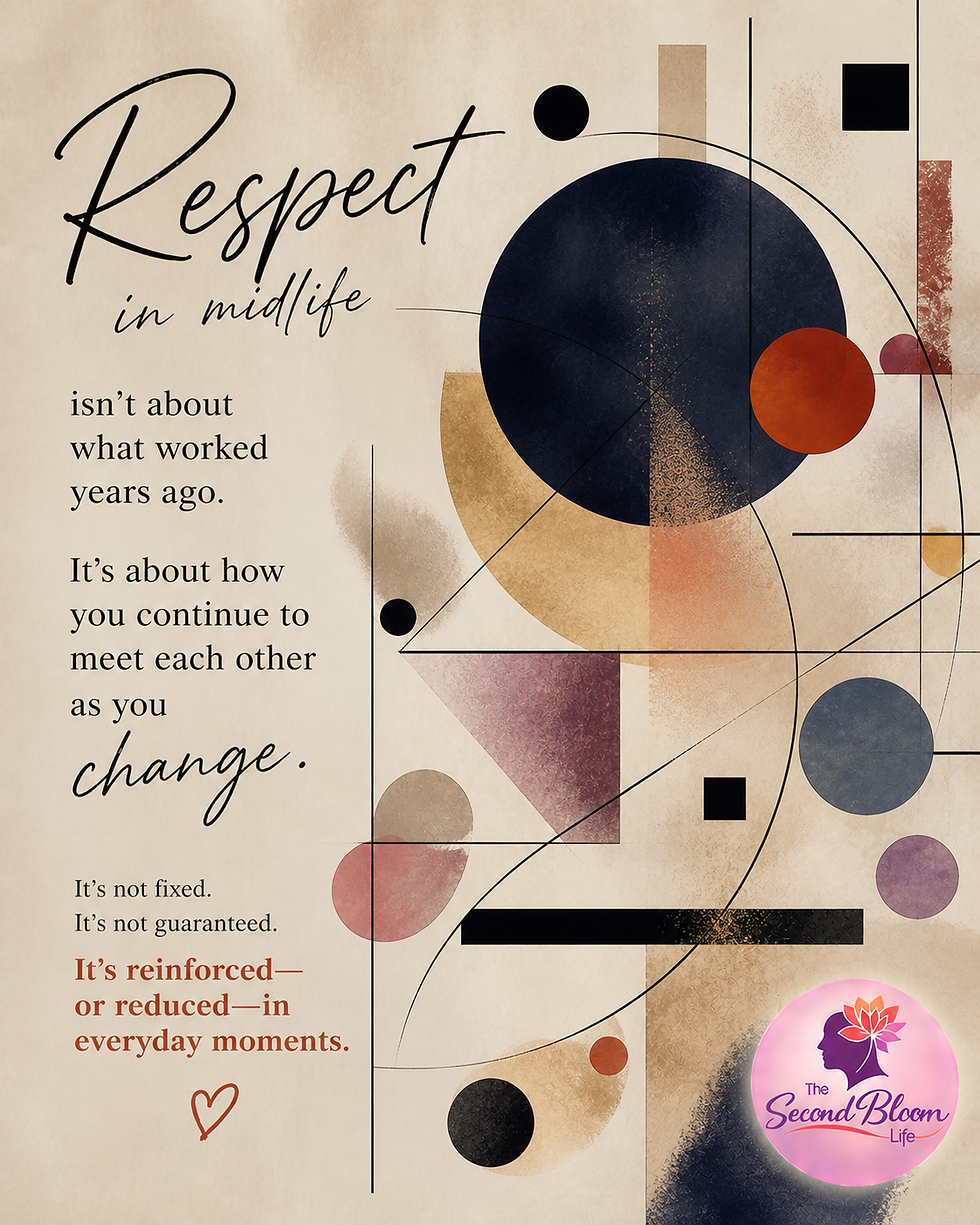
Respect in midlife is less about defined roles and more about how you continue to meet each other as you both change. It is not fixed, and it is not guaranteed. It is something that is reinforced — or reduced — in everyday moments. And while it may not always be as visible as trust or as frequently discussed as communication, it underpins both. Without it, conversations become strained and trust becomes uncertain. With it, even differences can be navigated with steadiness.
🌸 In the next post, we’ll explore how to rebuild and strengthen respect when it has quietly shifted over time — without blame, and without overcomplicating the process.


Comments