Why Hotel Rooms Make Us Dream Bigger
- thesecondbloomlife
- 6 days ago
- 5 min read
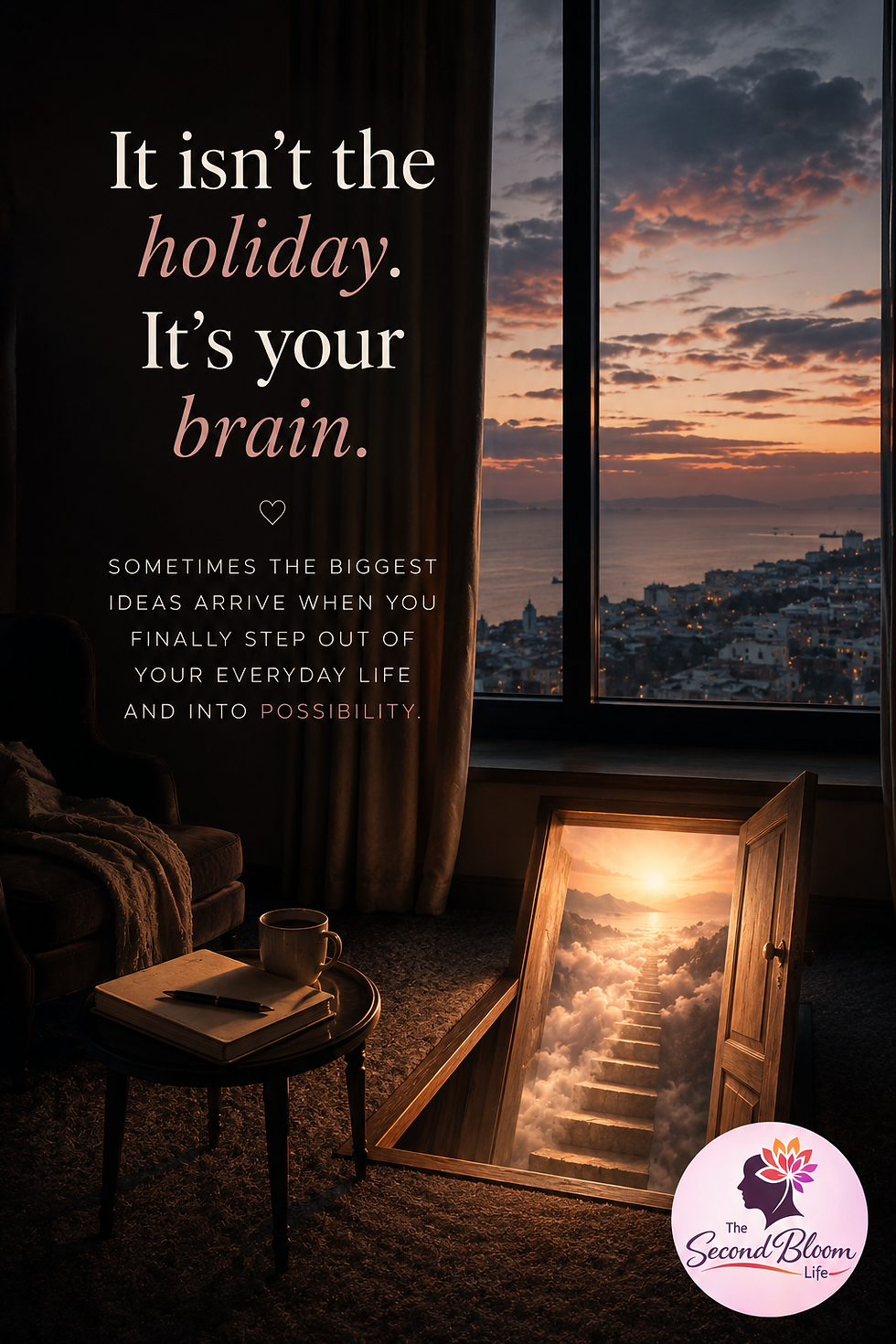
It isn't the holiday. It's your brain.
Some of the biggest decisions of my life have never happened in my own living room. They've happened in hotel rooms — sometimes overlooking the sea, sometimes in tiny city apartments, sometimes in airport hotels where the only view was another concrete building. And yet, somehow, those unfamiliar rooms have hosted conversations I've never quite managed to have with myself at home. Maybe it's time. Perhaps I'm ready. What if I actually did it?
It used to puzzle me — why does life always seem clearer hundreds of miles from home? Then I came across something that made it make sense. It probably wasn't the holiday. It was my brain.
Home Is Wonderful. It's Also Full of Instructions
Walk into your home and really look at it. The laundry basket, the unopened post, the calendar, the shoes by the door, the dishes, the bills, the chair where you always sit, the cupboard you've been meaning to organise. Every single object quietly reminds your brain who you are: mother, partner, employee, carer, problem solver, cook, taxi driver, responsible adult. Without saying a word, your environment constantly reinforces your identity.
Environmental psychologists call these behavioural cues. Our surroundings don't simply hold our belongings — they shape our behaviour, far more than most of us realise.
The Hotel Room Has No Memory
Now imagine opening the door to a hotel room. Nothing belongs to you. Nobody needs anything from you. There are no unfinished jobs, no familiar routines, no pile of washing silently accusing you, no kitchen reminding you to prepare dinner, no calendar on the fridge, no drawer full of paperwork. For the first time in months, perhaps years, your environment stops telling you who you've always been.
That's remarkably powerful, because when your surroundings stop reinforcing yesterday's identity, your mind finally has room to imagine tomorrow's.
Your Brain Loves Predictability
Neuroscientists point out that the brain is wonderfully efficient — it automates almost everything it can. That's a good thing; imagine having to consciously relearn how to brush your teeth every morning. Habits save enormous amounts of mental energy. But habits also build invisible walls around us: the same route, the same breakfast, the same chair, the same evening programme, the same conversations. We stop noticing our own lives because our brains have become extremely good at predicting them.
The unfamiliar interrupts that prediction. And interruption, it turns out, is where possibility lives.
I Always Journal More When I'm Away
It's something I've noticed for years. I barely touch my journal some weeks at home. Then I go away for three days and suddenly I've written twenty pages. Not because I became wiser overnight, but because my mind finally had room to speak — without interruptions, without routines, without constantly switching between ten different responsibilities. Silence has a remarkable way of introducing us back to ourselves.
The Psychology of Psychological Distance
Researchers describe something called psychological distance. When we step away from our everyday environment, we also step away from our everyday thinking. Problems that felt overwhelming on Monday can seem manageable by Thursday — not because they've changed, but because our relationship to them has.
Distance creates perspective. It's why advice is often easier to give than to follow: we see other people's lives clearly because we aren't standing inside them. A hotel room, in its own small way, lets us become an observer of our own life for a while.
Why Midlife Makes This Even Stronger
By midlife, many of us have spent decades building routines. Some serve us beautifully. Others have quietly outlived their usefulness — the difficulty being that routines rarely announce when they've stopped working. They simply become normal, until one morning you're sitting on a balcony in another country thinking, "when did my life become so automatic?"
It's one of the reasons travel feels different after fifty. We're no longer collecting passport stamps. We're collecting perspective.
The Balcony Conversation
I remember sitting on a hotel balcony early one morning. The city hadn't quite woken up. No agenda, no notifications, no rushing — just birds, coffee, and quiet. I found myself writing a sentence that surprised me: "I've been managing my life beautifully — but have I actually been living it?"
No dramatic crisis had led me there. No breakdown, no disaster. Just enough quiet for one honest question. Sometimes that's all reinvention ever begins with.
But Here's the Good Part: You Don't Actually Need a Hotel
This is perhaps the biggest lesson I've learned from all this. It isn't the hotel that changes us. It's the interruption — the pause, the permission to stop. And you can create that at home. Take your morning coffee somewhere you've never sat before. Walk a different route. Leave your phone behind for an hour. Visit a museum alone. Read in a park instead of on your sofa. Book yourself into a local hotel for a single afternoon with nothing but a notebook. Novelty wakes the brain up, and an awake brain asks different questions.
A Coaching Challenge
This week, create your own "hotel room moment." You don't need to travel — simply remove yourself from your normal environment for one hour. No errands, no shopping, no productivity. Take only a notebook, and ask yourself: if nobody expected anything from me tomorrow, how would I spend my day? Don't judge the answer. Just notice it. Sometimes the answers we've been searching for don't arrive because they're hiding. They arrive because we've finally become quiet enough to hear them.
A Final Reflection
In my work as a coach, I've learned that clarity rarely arrives while we're rushing. It shows up in the pauses — in unfamiliar places, slow mornings, quiet cafés, train journeys, walks beside the sea, rain against a hotel window. Those moments aren't magical because of where they happen. They're magical because, for a little while, the noise of ordinary life stops speaking, and you can finally hear yourself.
Perhaps that's why so many life-changing decisions begin in hotel rooms — not because they're luxurious, but because they briefly let us become strangers to our own routines. And sometimes becoming a stranger to your routine is exactly what lets you recognise who you've been becoming all along.
Reflection for This Week
Create one hour that feels like you're away from your own life — no responsibilities, no routine, no expectations, just curiosity. Then write one sentence: the life I'm longing for looks like... Don't worry about whether it's realistic. Today isn't about changing your life. It's about hearing it.
Coming Next in The Unexpected Psychology of Midlife
The Chair You Always Sit In
What if the seat you've chosen for years is quietly reinforcing the identity you've been trying to outgrow? Families don't just share homes — they also inherit invisible roles. And sometimes changing your seat changes far more than your view.


Comments