Why We Keep Clothes for the Woman We No Longer Are
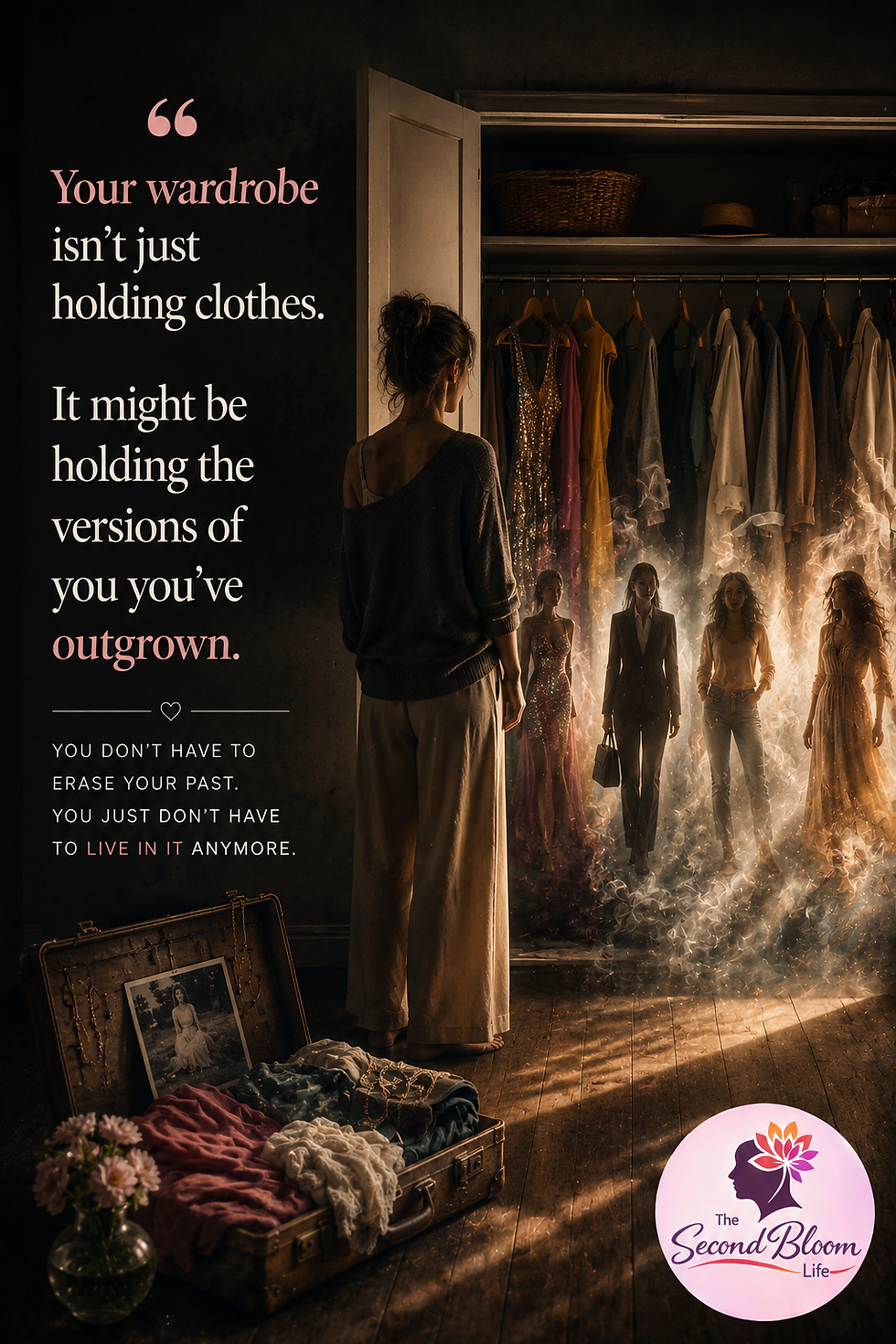
Your wardrobe may not just be storing clothes. It may be storing identities.
I went looking for a jumper last weekend and found three different women instead.
There was the tailored jacket from a career chapter that ended a decade ago. A dress bought on the promise I'd fit into it "by summer" — a summer that has since come and gone more times than I'd like to admit. A pair of impossibly high heels that once made me feel unstoppable and now looked, frankly, like they belonged to somebody I'd only met briefly. And right at the back, half-hidden behind a coat, a blouse I hadn't touched in over ten years — not because I disliked it, but because the woman who used to wear it simply doesn't exist anymore.
Standing there with my arm still buried in hangers, it occurred to me that a wardrobe isn't really a wardrobe. It's a museum. Not of fashion — of identity.
We tell ourselves we hang onto clothes because they're practical, because you never know, because it still fits (technically). And sometimes that's the honest reason. But more often, if we're being truthful, we keep them because they're witnesses. The dress from your daughter's graduation. The jacket from your first real interview. A scarf from a weekend in Paris you still think about. A jumper your mother knitted with her own hands. The shoes you danced in until 2am, once, a long time ago. Each piece carries a memory folded into the fabric, and every time you brush past it on the rail, it asks the same quiet question: remember who you were?
Then there's the other category — the one almost every wardrobe seems to have, tucked in a corner or a drawer that doesn't quite close. The jeans for when you lose the weight. The dress for when someone finally invites you somewhere glamorous. The outfit for when you feel more confident. The swimsuit for when you're comfortable in your own skin again. Look closely and you'll notice these clothes were never really waiting for a season. They were waiting for permission.
Psychologists have a term for this — possible selves, the future versions of ourselves we hope for, dread, or half-expect to become. That blue dress hanging untouched isn't just fabric; it's optimism, folded on a hanger. The running shoes still in their box aren't shoes; they're the woman who finally puts herself first. The expensive blazer isn't clothing; it's the entrepreneur you still, somewhere, believe you might become one day. None of that hope is misplaced — hope is what keeps us moving forward at all. But left unchecked, hope has a way of curdling quietly into postponement.
I owned a camel coat once. Elegant, timeless, genuinely expensive — the kind of coat you buy once and expect to keep forever. I hadn't worn it in years. Every so often I'd open the wardrobe, see it, and think, "I really should donate this," then close the door and carry on with my day. Months went by like that. Eventually I understood I wasn't holding onto a coat at all. I was holding onto the woman who'd bought it — ambitious, perpetually busy, certain she knew exactly where her life was headed. Giving away the coat felt, for a long time, like admitting that woman had changed into someone else. But the day I finally did it, I didn't feel loss. I felt space. Clearing out a wardrobe, it turns out, is often less about the clothes and much more about making room for whoever you've actually become.
Nobody warns you about this part of midlife — that grief doesn't only visit us through people. Sometimes we grieve identities instead: the athlete we used to be, the young mother, the woman scaling the career ladder, the daughter whose parents were always simply there, the version of us who assumed there would always be more time. These losses don't come with funerals or flowers or sympathy cards. But they're every bit as real, and I think that's part of why certain clothes become almost impossible to throw away — they're physical proof that a particular chapter genuinely happened.
None of this is really an argument for emptying your wardrobe out this weekend. It's an invitation to something smaller and more honest: curiosity. Pick up one item you've held onto for years and ask yourself plainly — am I keeping this because it still reflects who I am, or because I'm not quite ready to say goodbye to who I used to be? Sit with whichever answer arrives, even if it isn't the one you expected.
I tried on a dress recently that I'd kept for years, and it no longer suited me — not because of my size, but because of my life. The colours felt wrong on me. The cut felt like someone else's decision. And the woman looking back from the mirror smiled, not with disappointment but with something closer to recognition. I wasn't trying to fit into the dress anymore. I'd been trying to fit back into an old version of myself, and I finally understood that was never actually the point.
Try imagining, just for a moment, opening your wardrobe tomorrow morning and finding that every single item fits, every colour feels unmistakably like you, and nothing on the rail whispers "maybe one day" or "you used to be happier" or "you were supposed to become someone else by now." Instead, everything in there simply celebrates the woman standing in front of it. That would feel lighter, wouldn't it — a little like exhaling after holding your breath without noticing.
So here's something worth trying this week. Choose one item you've been keeping "just in case." Hold it for a moment, actually remember the woman who wore it, and thank her — she got you this far, after all. Then ask, simply, does she still need this? If the honest answer is no, let it go and become someone else's beginning instead of your unfinished business.
Reinvention, in my experience as a coach, rarely starts with a new purchase. It usually starts with releasing something old, gently and without resentment — not because the past wasn't worth living, but because the future deserves some room to breathe too. Our wardrobes tell the story of everywhere we've been. They don't have to stay archives, though. They can become an invitation instead — to dress the woman who's actually here today, not the one you were, and not the one you once assumed you'd have become by now.
She deserves good clothes too. Not once she loses the weight, not once life calms down, not once confidence finally shows up on schedule. Now. Because perhaps the most elegant thing any of us can wear in midlife is simply an honest acceptance of the season we're actually standing in.
Next time you open that wardrobe door, try asking a different question than usual. Not "does this still fit me?" but "does this still fit my life?" You may find the answer has very little to do with the clothes at all, and everything to do with the woman wearing them.
Coming next in The Unexpected Psychology of Midlife — Why We Keep Rearranging the Furniture When Life Feels Stuck. Have you noticed how, just before a major change, people so often repaint a room, shift the sofa, or buy new cushions? It's rarely about décor. Sometimes it's the mind quietly rehearsing a fresh start before the heart is ready to admit it wants one.


Comments