Why We Read the Same Book Again
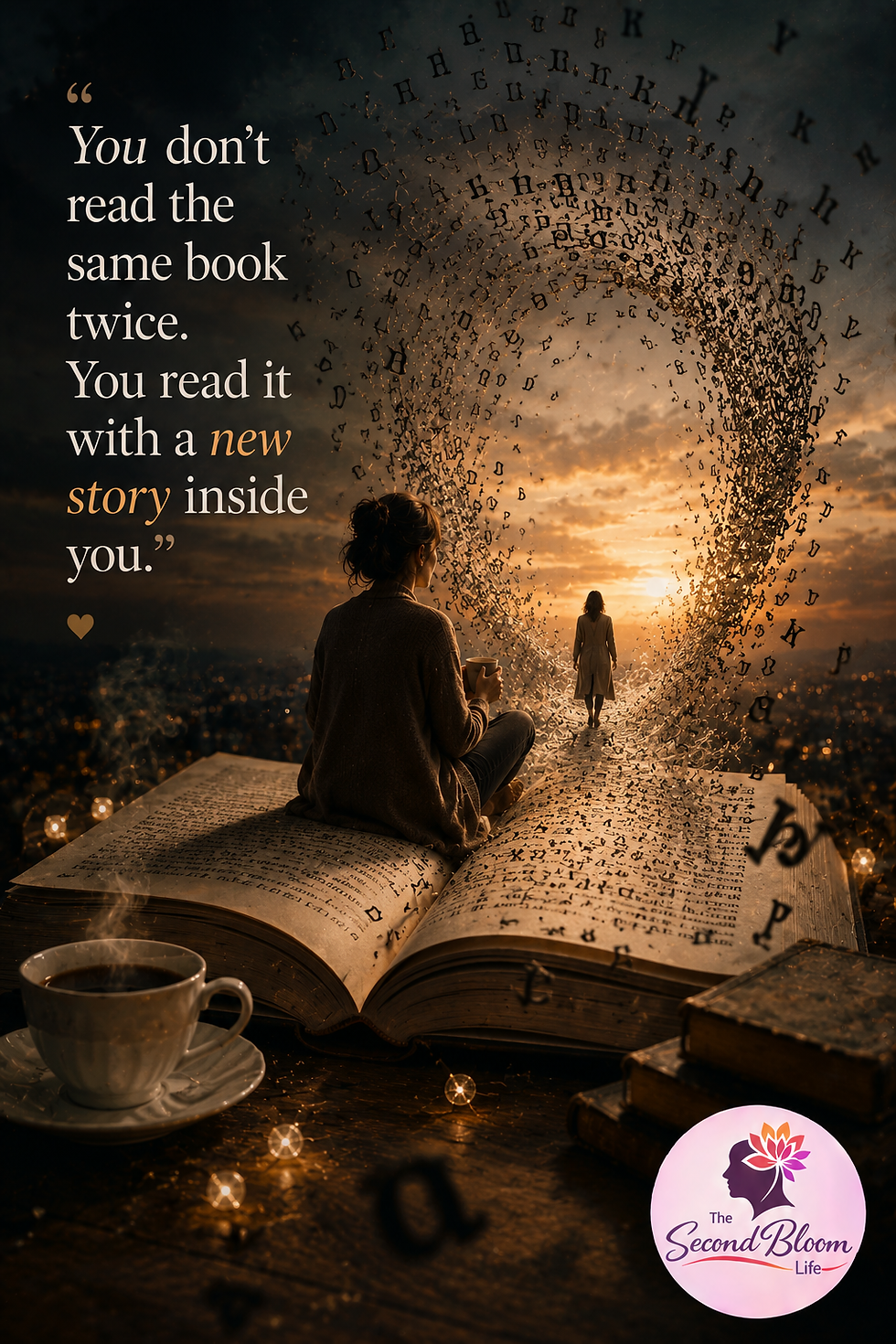
The story hasn't changed. You have.
Last winter I reached for a novel I'd already read twice. I knew every major twist. I knew precisely how it ended. I could half-recite certain lines of dialogue before my eyes even reached them on the page. By any sensible measure, this made no sense whatsoever — there were hundreds of unread books sitting patiently on my shelves, and yet my hand walked straight past every one of them and picked up the story I already knew by heart.
Curled up with a cup of tea, I found myself asking a question I'd never quite put to myself before. If I already know how it ends, what on earth am I hoping to find? The answer, once it arrived, wasn't the book at all. It was me.
Then: a reader hunting for plot. Now: a reader hunting for herself.
There's a line often credited to Marcel Proust — that the real voyage of discovery lies not in seeking new landscapes, but in acquiring new eyes. Whether or not the novel on your lap is the same one you read at twenty-five, you are, without question, never quite the same reader twice. The woman who first opened Pride and Prejudice in her twenties isn't the woman who opens it again at fifty-five. The words on the page haven't shifted an inch. Everything around them has: grief happened, love happened, disappointment and recovery happened. The story holds still. We don't.
Ever gone back to a book from childhood expecting a simple wave of nostalgia, and found wisdom sitting there instead — wisdom you'd completely missed the first time round? A sentence that once felt entirely ordinary can suddenly land like a small revelation. A character you once dismissed starts making painful sense. Someone you used to admire without question no longer earns quite the same regard. It's tempting to assume the book itself changed while it sat gathering dust on the shelf. It didn't, of course. Your life rewrote the meaning while you weren't looking.
Then: skimmed past without a second thought. Now: underlined twice and read aloud to no one in particular.
Neuroscientists describe memory as something far less tidy than a filing cabinet — every time we recall something, we're not retrieving it intact, we're rebuilding it from scratch. Which means every rereading is really a conversation between two separate stories: the one fixed on the page, and the one you've been quietly living since you last closed the cover. That may explain why certain books seem to arrive at exactly the right moment. They probably didn't time it deliberately. More likely, we simply became ready, at last, to hear what they'd been saying all along.
I tried one particular novel in my thirties and abandoned it halfway through — slow, dense, faintly irritating, I thought at the time. Years later I picked it back up almost by accident, and could not put it down. Nothing inside the book had shifted a comma. Everything inside me had. I'd since learned patience the hard way, learned loss, learned something about forgiveness I hadn't had cause to learn before. The questions that novel had been quietly asking all along had finally become questions I was living myself. Sometimes a book hasn't failed you. It's simply been waiting for you to catch up with it.
Then: "what happens next?" Now: "has anyone else ever felt exactly this?"
Somewhere around midlife, most of us stop reading purely for information and start reading for recognition instead. A paragraph describing loneliness. A single sentence about quiet courage. A widow making tea for one. A woman changing careers later than she'd planned. A father visibly ageing on the page. These stop being fictional details and start behaving like mirrors. It's probably why so many women return to novels they loved decades earlier — not really to revisit the plot, but to revisit themselves as they used to be, and measure the distance travelled since.
There's one novel of mine that never stays on the shelf for long. It isn't a classic. It would be unlikely to make anybody's list of the greatest books ever written. And yet every few years it finds its way back onto my bedside table entirely of its own accord. Each time, I underline different sentences. Different passages catch in my throat. Different questions linger after the light goes off. The book hasn't grown any wiser in the meantime. I have.
There's a tidy psychological explanation for part of this too. Familiar stories genuinely reduce uncertainty — knowing the ending in advance allows the nervous system to relax its guard, freeing our attention to move from what happens to why it matters. That may be exactly why we reach for reread books during the harder seasons of life. We're not after surprise in those moments. We're after steadiness, and certainty has a way of becoming its own quiet form of comfort when everything else feels unmoored.
If you'd like to test this on yourself, find a book that once meant something to you — not expecting it to change your life this time, but half-expecting to notice that life has already changed you since the last reading. See which character reads differently now. Which line catches your breath in a way it never used to. Which chapter suddenly feels uncomfortably personal. Then ask plainly: who was I when I first read this, and who exactly am I now? Somewhere in the gap between those two answers sits a story you've probably never properly thanked yourself for surviving.
I've come to think the most powerful stories don't really live inside books at all. They live inside the people reading them. Every chapter we return to becomes a small, private reminder that we're still changing, still growing, still somewhere in the middle of becoming. Familiar books keep calling us home not because they hold all the answers, but because they gently surface the questions we've finally grown ready to ask. And perhaps that's closer to what midlife actually is — not a closing chapter, not even the start of an ending, but the rather beautiful moment we realise we've become wise enough, at last, to understand the story we've been living in all along.
Pick up a book you've loved before. Open it at random. Read one page, then close it again, and ask yourself which sentence now belongs to you in a way it never quite did the first time round. Sometimes the sharpest plot twist was never hidden in the novel at all. It was hidden in the reader.
Coming next in The Unexpected Psychology of Midlife — Why We Buy Blankets We Don't Really Need. The soft throw draped over the sofa. The oversized knit folded in the basket. The luxurious blanket bought despite already owning three. It was never really about staying warm. Sometimes it's about building a small pocket of emotional safety inside a world that so rarely feels predictable.


Comments